Ritual as Dissipation System

Ritual operates as a self-organizing dissipation system for ontological embodiment. Philosophers really know how to take all the fun out of something like ritual. Permit me to rephrase by saying that ritual permits the flow of energy, which is akin to a pathway or dissipation system. This idea is based upon David Depew and Bruce Weber theory of Non-equilibrium Thermodynamic as it relates to biological evolution as found in “Consequences of Nonequilibrium Thermodynamics for the Darwinian Tradition” and personal conversations with them along with Eric D. Schneider’s “Thermodynamics, Ecological Succession, and Natural Selection: A Common Thread.”

Self-organizing dissipation systems are stable over time but are also dynamic. These systems are pathways for excess energy. Being far from equilibrium, these systems are often non-deterministic. Systems, structures, and processes such as ecosystems, evolution, culture, weather, and cities are all subject to non-equilibrium thermodynamic. Based on this principal of the vast excess energy of the sun, ecosystems (as well as all these others ones) have developed into self-organizing dissipation systems.

Ritual may be understood as stable over time and dynamic. Ritual provides a structure for a plethora of human activities. So that ritual may be a self-organizing dissipation system for energy to flow through. Part of that energy is the basic for creating the ritual structure, which I am suggesting is ontological embodiment. Ritual then is a lived experience. (I may have taken ‘lived experience’ from Edmund Husserl but I am not sure if directly, it has been a long time since I have read anything by him, or if through some other philosopher.)

Ontology is the nature of being, which includes questions of what or how one interacts and understands existence and reality. This is part of the fundamental question of how things are in relationship. The embodiment part is our action, while ritual is a first-person experience. That is to say human perspective of the world becomes part of one’s being through ritual. This view is in agreement with the part of biogenetic structuralism that “[r]itual activity facilitates the penetration and embodiment of symbols into human selves” (Grimes 2006:139).

However, there are limits to ontological embodiment. Margaret Thompson Drewal wrote about the play in ritual and expands the idea of performance based upon the Yoruba-speaking people’s understanding. The Yorba are peoples of southwestern Nigeria who conceive ritual as “journeys” (1992:xiii). Ritual as journey speaks to ritual as a pathway for a flow of human activity, as for example, piety. The interplay of ritual, festival, spectacle, and play seems to push these boundaries by the “overlapping and interpenetrating” of the words themselves (1992:12). Drewal writes that “nobody can witness a Yoruba performance in its entirety, not even ritual specialists themselves” (2001:24-25). This speaks about the reality of living and having limits. In limits categories arise.

Hence, ritual becomes the frame in which religious and secular activities can manifest. Because neither ontology nor embodiment is limited to religious experiences, secular activities should be included. A good example of secular activities is Lee Gilmore’s Theater in a Crowded Fire: Ritual and Spirituality at Burning Man.

Works Cited

Depew, David and Bruce Weber. (1988). “Consequences of Nonequilibrium Thermodynamics for the Darwinian Tradition.” Entropy, Information, and Evolution. Ed. David Depew and Bruce Weber. Massachusetts: MIT Press.

Drewal, Margaret Thompson. (1992). Yoruba Ritual: Performers, Play, Agency. Bloomington and Indianapolis: Indiana University Press.

Grimes, Ronald L. (2000) “Ritual.” Guide to the Study of Religion. Ed. Willi Braun and Russell T. McCutcheon. New York: Cassell. Pp. 259-270.

— (2006) Rite out of Place: Ritual, Media, and the Arts. Oxford: Oxford University Press, Inc.

Schneider, Eric D. (1988). “Thermodynamics, Ecological Succession, and Natural Selection: A Common Thread.” Entropy, Information, and Evolution. Ed. David Depew and Bruce Weber. Massachusetts: MIT Press.
Posted in Philosophy, Piety, Ritual | Tagged , , , | Leave a comment

Aristotle and Confucius are Friends

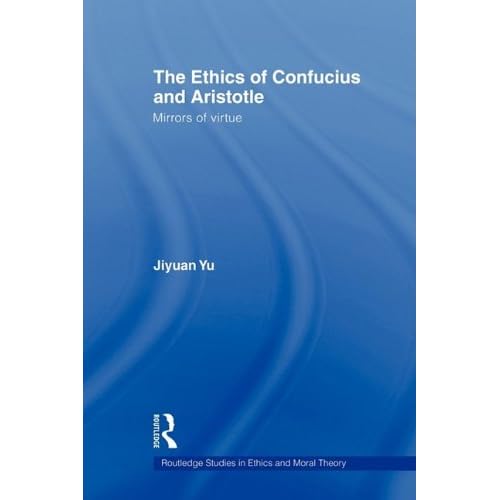
The Ethics of Confucius and Aristotle

The Ethics of Confucius and Aristotle

Yu, Jiyuan. The Ethics of Confucius and Aristotle: Mirrors of Virtue. New York: Routledge, 2007.

There are dangers with comparative philosophy. These include incommensurability, relativism, misinterpretations and heavy reliance on secondary sources (language), and Eurocentric standards. Jiyuan Yu faces all of these and tries to minimize each problem in his work comparing the ethics of Confucius and Aristotle beginning with addressing Alasdair MacIntyre’s concern about comparative philosophy. Yu suggests that both Confucius and Aristotle address core issues of being human. This type of claim has its own problems but Yu does work throughout his book on setting up a dialog of understanding of the two systems and even how they may address shortcoming in each other systems. Yu uses Aristotle’s own idea of friend as a mirror thesis as a basis for this type of comparison (p. 4).

Yu helped me with my own understanding of Confucius’ ethics by comparing it with Aristotle’s for which I was more familiar. Most helpful was Yu’s comments on the different kinds of ren. There is a general sense that means human excellence and a particular sense of benevolence. I am not sure if I am on firm ground with these different concepts because of my heavy reliance on secondary source (note this is one of the dangers of comparative philosophy) for Confucius but I am better able to appreciate the subtleties of Confucius thoughts. The author’s discussion of habit and ritual also provide me with much to think about. In fact, Yu pointed out many places of comparison that I would not have look towards.

The Ethics of Confucius and Aristotle has both a Greek and Chinese glossary. There are plethora of notes, selected bibliography, textually grounded discussion, index of names, and index of subjects. As a scholarly work, Yu has everything that I want. The thematic base of the chapters is helpful and Yu returns to ideas that he has built upon earlier.

Posted in Book Review, Philosophy | Tagged , , , | Leave a comment

Top 5 things I have learned about Blogging…so far

Being new to social media and starting a blog only a few months ago, I have gained some learning experience with this endeavor. From my very limited experience, I do have some things to offer, which I am sure in the years to come,  will look naive.

  1. It takes longer to set up your account than optimistic websites would lead you to believe.
  2. Just write, doing the work will help craft your skills.
  3. Read and comment on lots of blogs before starting one.
  4. Even if you tell your close friends, it may still take time for anyone to engage with your blog.
  5. Keep writing.

The friendly people who write that you can have a blog up and running in fifteen minutes are inviting but unless you have your bio, photos, content, and other little things in place then it may take an hour. Not that this is bad, I just am a little compulsive—just enough to take lots of time to make the blog look how I wanted but not so much as to not make mistakes.

I do make mistakes with writing, sometimes lots of errors.  So, I am fearful of pushing out blogs without some reviews. Well, if I am going produce a regular blog then I need to turn out blogs. Now, what I should do is work on my writing craft by reviewing my errors. By pushing myself outside of my comfort zone, I may grow into my craft.

Even with being new to social media, I knew there were lots of blogs. What I did not do was engage with other bloggers. I have made some comments over time but that is different than really engaging. So now I have content to write and other bloggers to engage with to be a good community member.

I have some great friends who are smart and insightful. My hope was they would read my blog and write comments, make suggestions, or even question what I meant. Good critical comments are helpful. I did have some nice comments but not the engagement that I would have like to have…yet. I know it will come as I continue to write. Also, my close friends talk with all the time. As I widen my circle of readers, I think that I will have people provide the comments that I would like.

So with few people reading my blog, why write. Well, I need to give this a chance. I am not well known nor am I selling a product. I am simply a person writing on what I know who would like a few other people to read and make comments to engage with. What I need to do is give people a chance.

Posted in General Post | Tagged | 2 Comments

Authenticity and Paganism

I attended Sabina Magliocco’s (Professor of Anthropology at CSU Northridge) “Folklore, Culture & Authenticity in modern Paganism” on Thursday for the Cherry Hill Seminary Winter Conference in San Jose. PantheaCon provided the room for our Winter Conference.

Sabina raised may good questions which led us to more good questions. Being a philosopher, this was a great time for myself and will give me plenty to think about for the next few years. The basic question is what counts as authentic within modern Paganism? Sabina express this through her field of study—folklore. There were lots of questions and great discussion. However, I am going to address just one point, which I think is key to the issue of authenticity that of context.

In general, I do not believe in idea of an absolute truth where there is one final, correct truth that is universal such as neo-Platonic ideas of the forms or the one. Being a polytheist, I feel there are multiplicities of truths. What counts as authentic is in context with what is being examined. Modern science provides a great methodology of determining truth within the confines of a material world where there is an agreement of observable and reproducible experiments that lead to a common language reviewed by peers. There is lots of math and counting involved. If I wanted to understand the material components of stars, I would ask an astronomer; however, that does not mean Vincent Van Gogh’s Starry Night is not an authentic representation of stars. If I wanted to understand the nocturnal beauty of stars then Van Gogh’s work is authentic and speaks to a truth about the nature of the stars.

So what then is authentic Paganism? What would I count as warranted facts? I tend to look at historic evidence within the framework of a conservative academic approach. So that I tend to reject unverified personal gnosis (UPG) is not because I think it is not true only that I do not include it with what I think is warranted for historical evidence. It often lacks verifiability and any kind of peer review nor should someone’s experiences be subject to these kinds of tests. Self-identification as a modern Pagan is simple good enough for me to accept a person as Pagan. I may ask questions, what good philosopher would not; yet, for the most part, a personal claim seems to be all that I really need. Anymore and I worry that a person would need to create some kind of authority, history, or credential to pass as Pagan. I do not mean lie, only look for what they would think of as authentic. I may judge my own Paganism through the lens of a post-modern humanist view point but I would not want all to do so. My context is not suited to all people. I may reject UPG; however, I am still left with a very personal opinion on what warrants do I permit to inform my actions, experiences, and believes.

Posted in General Post | Tagged , | 2 Comments

What is Piety

What do I mean by piety (Єύσέβεia )? Well, I would be remiss if I did not begin this journey about piety without acknowledging Socrates’ famous question. Plato, in his Euthyphro, has Socrates ask Euthyphro about piety. There many definitions for piety suggested—Socrates is all about definitions. As is often the case for Socrates, well at least as Plato portrays him, all the suggestions about what piety are rejected and at the end Socrates recommends they start from the beginning. I shall take that advice but I will not be focusing on Plato’s ideas as presented through his writings on Socrates. However, I will leave with that I agree with John Hardwig who stated “Socrates’ understanding of piety—piety is moral conduct and nothing more” (261). I am not inclined to use phases such as “nothing more” even if I think that Plato may have had that in mind. But there is a close connection between piety and morality.

Piety seems to imply showing reverence or devotion to a deity, relationship, and community in which both duty and virtue come to mind. I am reminded of Robert Parker’s remarks about sixth century Athenian festivals and if they are religious, in which he suggest that “[p]utting on a show in a way ‘worth of the god’ was an act of piety” (79). Worthy actions are at the root of piety. Just as morally only makes sense in connection to relationships, so too for piety.

Yet , there are some negatives response to piety. W. Warde Fowler suggests that pious “suffered damage from the sanctimoniousness of the certain type of Puritanism” (462). Whereas, “piety still remains sweet and wholesome’ (Fowler 462). Also, I found it interesting that for Paul Tillich, piety is good so long as a person conforms to the will of God in which nothing is done for the sake of becoming a pious person for one’s self. His idea is that “…in its distorted form, ‘piety’ becomes a tool with which to achieve a transformation within one’s self.” (Tillich 86).

Within Paganism, I think that I am on firm ground with acting with reverence towards our essential relationships in which we can achieve our own personal transformation is not only a good thing but rises to the level of becoming a core value of Paganism. I will shy away from listing core values of Paganism in general, nor do I think that there would ever be a single stagnant list. Overtime I will suggest some of the core values of Pagan Humanism some of which may be include with many other types of Paganisms.

Piety then is our actions with regards to essential relationships such as those towards deity, community, nature, and ourselves. This is way I often describe Paganism as a people of piety. Then I follow-up with piety is building right relationships. I enjoy this Paganism in one or two sentences. Although, I would not suggest that everyone use this same description, I would encourage each Pagan to have their own short description ready.

Citations

Fowler, W. Warde. (1971). The Religious Experience of the Roman People from the Earliest Times to the Age of Augustus: The Gifford Lectures for 1909-1910 Delivered in Edinburgh. New York: Cooper Square Publishers, Inc.

Hardwig, John “Socrates’ Conception of Piety.” Teaching Philosophy, 30:3 (Sept), 259-268.

Parker, Robert. (1997). Athenian Religion: A History. Oxford: Clarendon Press.

Tillich, Paul. (1967). Systematic Theology: Three Volumes in One. Chicago: The University of Chicago Press.

Posted in Piety | Tagged , , , , , | 3 Comments

Medieval History & Witchcraft

Battling Demons by BaileyBailey, Michael D. Battling Demons: Witchcraft, Heresy, and Reform in the Late Middle Ages. University Park, Pennsylvania: The Pennsylvania State University Press, 2003.

The focus of Battling Demons is Johannes Nider (d. 1438), a Dominican theologian. Bailey focuses on the connections with heretical movements and increase persecution of witches. He asserts that witchcraft, as it became known as a concept in the late Middle Ages, had a place in the growing turmoil and crisis within the religious communities (between the time of the Great Schism of 1378 and Luther’s break with Rome of 1521). He states that “witchcraft was not an isolated concern of Nider’s: his particular interest in witches and their malevolent activates was closely related to his other religious concerns” (140). The witch craze was not an isolated event but part of a larger response to what seemed like the growing threat to the Western Christendom.

To Bailey, persecuting witches had little to do with those remnants of European Pagan culture. It was a response to what seem to be the increase demonic forces at work. To oversimplifying it, people of the Middle Ages thought that there must be witches because of the religion turmoil in which the Devil must be working again Western Christendom. It was this idea of crisis that would lead to the narrow definition of a witch, which did not come into focus until 1430’s being fully stereotyped with the 1487 Malleus maleficarum (30). Bailey follows the origins of witchcraft in clerical thought along with showing Nider’s influence by popular accounts. Much of Bailey material is taken from Nider’s Fomicarius. Bailey discusses such topics as inventing the Sabbath, women as witches, heresy, and reform.

Bailey uses the specific example of Nider’s writing to illustrate he overall view of the development of the concept of the witch.  I feel this is a good use of Nider’s work and helps us understand one part of the devolvement of concept of witchcraft. I do not see his book as meaning to explain the whole devolvement nor address the remnants of Pagan culture. For that look to Carlo Ginzburg as a starting place. The book has great notes, a reasonable bibliography and index, and three appendixes. At 200 pages, it is a great short look at a specific time and place.

Posted in Book Review | Tagged | Leave a comment

Straw Art at PantheaCon

Welsh Fan, Love/Harvest Knot, Brigit's Cross

Welsh Fan (top) , Harvest Knot (right), Brigit's Cross (left)

The Woven Circle will be teaching two traditional wheat weaving classes at the 2011 PantheaCon. The Woven Circle is made up of talented artists who travel to San Jose each year to share their enjoyment of straw art with the Pagan community at PantheaCon.

There will be a beginning class “Introduction to Wheat Weaving” on Saturday. This class focuses on beginning weavings techniques along with straw preparation and sources on books, materials, and local groups. In this class, each student will make at least two weaving: a Bridget’s Cross and Harvest Knot to bring home. All materials and supplies are provided.

We will be teaching an intermediate class “Intermediate Wheat Weaving” on Sunday for those of you who have taken wheat weaving classes and advance hand crafters. This class focuses on intermediate weaving techniques. In this class, each student will make a Welsh Fan using a locking technique and hair braid for a hanger. All materials and supplies are provided.

The Woven Circle (Angela, Carol and William) is dedicated to teaching arts and crafts as part of our service to the community. Angela is an eclectic Pagan writer and has taught crafts for 20 years. Carol is a bead and fiber artist, who has taught for crafts guilds, both local and regional. William (author of A Pagan Humanist blog) has been part of the Pagan community for over 30 years and had been teaching wheat weaving for over 15 years.

Resources for Straw Art

You can buy straw from Black Beard in North Dakota (from Dennis and Sharon Hanson). Also, you can find wheat at Frank’s Cane & Rush Supply (7252 Heil Ave. Huntington Beach, CA 92647 – (714) 847-0707). Both good place, and good people, to buy from.

We recommend two books (yes there are more books but this should start you out just fine):

  • The Book of Wheat Weaving and Straw Craft: from simple plaits to exquisite designs. Morgyn Geoffry Owens-Celli. 1997
  • Wheat Weaving Plaits & Projects: A Beginner’s Book. Edited by Nan Rohan. Published by The California Wheat Weavers Guild

The American Museum of Straw Art host a spectacular collection of straw art from the US and around the world.

Also, there is Wheat Goddesses, which is Cora’s web site about where she will be at. Her work is amazing and if you get a chance, please stop by one of her shows to see all the straw art.

Posted in Classes and Workshops | Tagged , , | 6 Comments

Pagan Conference 2011

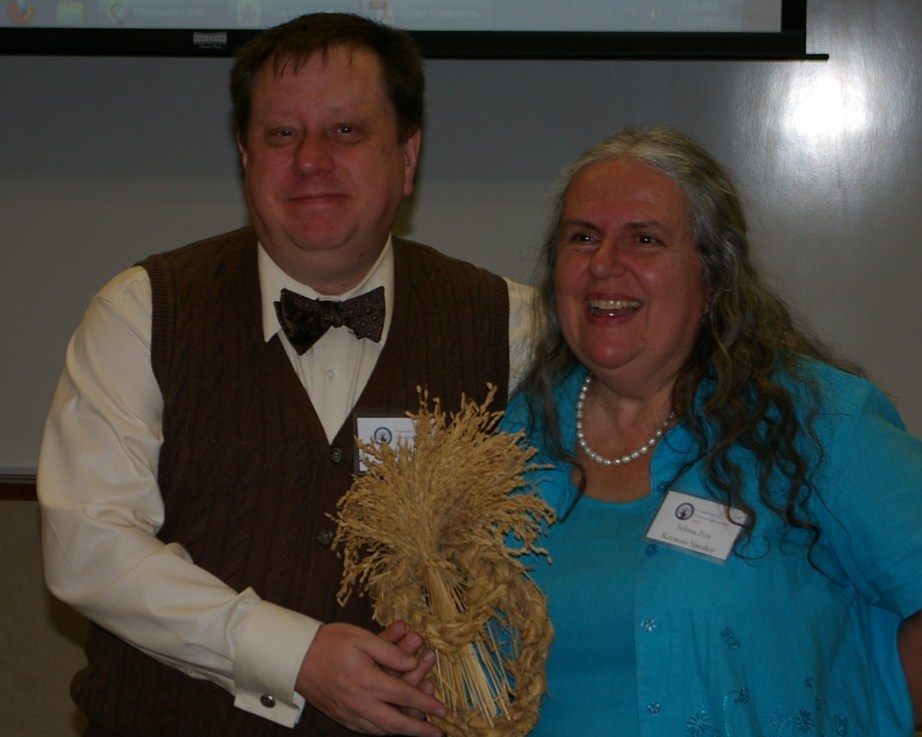
Selena (Circle Sanctuary) with William. Photo by Angela Pearson

I am fortunate to serve on the Annual Conference on Current Pagan Studies’ (Pagan Conference) Board of Directors.  A little over a week ago we had our Seventh Annual conference at the Claremont Graduate University in California. There were two outstanding keynote speakers: Patrick McCollum and Selena Fox. Both were great speakers; however, what makes both of them truly outstanding is how they manifest—through actions—their commitment to social justice for Pagans, other religious practitioners, and others throughout the world. The commitment to taking actions is one of the key elements with Pagan ethics where we serve our community, other people, deity, and nature.

Each year, presenters at the Pagan Conference seem to emphasize the need to take action for environmental and social justice causes. I am lucky that in my daily work, I develop and work on programs that involve public safety; I interact with other Pagans; and serve some Pagan organizations. Yet, hearing Patrick and Selena speak did make me question whether I am doing all that I can. One reason that I started my blog is that I wanted to become better at written communication and to engage others with my understanding of philosophy.

This past weekend, I attended a California State University, Fullerton philosophy alumni meeting. One of our recent graduates was presenting his application to some Ph.D. programs. What he wanted to convey in his writings was how philosophy could engage with political and social causes. He wanted his work to affect change in the world. I think that from a Pagan perspective, our beliefs matter in so much as they produce actions.

The question that I need to keep asking myself is whether my work is producing actions; that is, am I making a positive difference in the lives of people I hold dear, the causes that I feel strongly about, and my community.

Posted in General Post | Tagged , | 2 Comments

Pagan Piety

Descriptions of Paganism seem froth with subjectivity, addendums, and conditional language which may lead a listener down a confused path. These twists and turns are clumsy just when clarity is needed. Many words and phrases are used to describe the core nature of Pagan religion. Some of these include earth-based, nature worship, ancient, and pre-Christian. All of these have their merits and limits. There is another problem with the word “pagan.” It has long been used in a derogatory form. Even in the light of religious tolerance; Pagan still lacks many of the positive connotations afforded other religions. In order to address these twin plights of bringing precision and positive meaning to Pagan, I suggest that the ancient Greek word Єύσέβεia may be used as a central theme of Pagan religion, the idea of piety as Pagan religion. I argue that at the heart of Paganism is piety; be it reverence for the gods, earth, or other humans. Piety is the right action towards a relationship, the idea of orthopraxy (όρθοπραξις).

The association of positive words with Paganism can be beneficial in the attempt to educate people on the roots and beliefs of Paganism. The word piety may suffer from its being used to suggest over exuberance in religious matters. Yet, it still adds an overall positive connotation to Paganism as well as providing a simple and understandable description of a core Pagan value. What may be of more value is that the Pagan community may see themselves as pious in the context closer to what some ancient Pagan people would have understood.

Posted in Piety | Tagged , , | 5 Comments

Wecome from a Pagan Humanist

Welcome to A Pagan Humanist, I am William and my blog provides a means for me to engage with a larger audience than my circle of friends and local events. With that, permit me to provide some background about me. I have been actively engaged as a Pagan for over 30 years. This means that I been part of and founded groups; worked with other Pagans; attended both private and public rituals; taught; drummed; danced; expressed my views; been interviewed by the media; held offices; attend and taught at festivals; counseled others; made mistakes within the community; changed my opinion over time; learned; been too stubborn to learn; read; donated time and money; and a whole plethora of other stuff. However, by no means am I an elder in a tradition or the community. Mostly, I think that I am an average Pagan who has been around long enough to be involved with some very interesting local groups, people, and events.

I have an academic tendency in my studies where I engage in religious philosophy within a Pagan context. I serve on the Board of Directors of Cherry Hill Seminary and the Conference on Current Pagan Studies. In part, this blog is my means of expressing those ideas that I think about, which includes Paganism as Piety (Єύσέβεia), Applied Ethics, Religion and Science, Greco-Roman Moralist, Philosophy, Aristotle, and Evolutionary Theory. Along with my academic tendencies, I provide Project and Program Development for local government and non-profits with some data and statistical analysis.

Posted in General Post | Tagged , , , | 4 Comments