Thomas Schwartz and the Identifiable Fallacy

Thomas Schwartz, in his “Obligations to Posterity,” claims that there are no moral obligations to future persons based on the identifiable fallacy.[1]Any action that changes the future means that those persons born would be different than those who would have been born if nothing was done. A paradox is created in which the person being born would not have been born if something else was done.[2] Schwartz also has pointed out that if we do nothing for the future, those individuals being born into that future world cannot blame us, unless that world is so horrible that it would have been better not to have been born, for if we did anything else, they would not be the same individuals and therefore could not have been better off.[3] In this sense, we cannot harm nor benefit future generations[4].

This philosophical paradox leaves us with a very perplexing problem—to do anything is to change the individuals that we are trying to benefit and although future persons may be thankful that we did something, but we cannot be held morally accountable for our actions or inactions. The difference is between the idea actions of being morally obligated versus merely morally permissible.

For example, if a nation would adopt a policy to reduce population growth with the intent to ensure that future generations would be able to enjoy the persevered natural world that would not be needed to support a larger population, then different people would be born—especial for distant future generations.  This seems to hold true for any change in social patters such as population mobility, technology, and growth. Schwartz’s claim that we cannot be held morally responsible for what happens to future generations is still one of the major theoretical concerns to our responsibility to future persons.


[1] “Whatever we may owe ourselves or our near posterity, we’ve no obligation extending indefinitely or even terribly far into the future to provide any widespread, continuing benefits to our descendants. This contrary claim rests on the identifiable fallacy” from Thomas Schwartz “Obligations to Posterity,” in Obligations to Future Generation, ed. R. I. Sikora and Brian Barry (Philadelphia: Temple University Press, 1978), 3. Also see “The standard approach in conventional economic analysis,” writes Davidson “is to discount future climate damage because future generations are empathically remote from us and are expected to be much wealthier.” Marc D. Davidson, “Wrongful Harm to Future Generations: The Case of Climate Change,” Environmental Values 17.5 (2008), 472. Parfit asks us to consider whether, “even if railways and motor cars had never been invented, I would still have been born” in Derek Parfit, Reasons and Persons (Oxford: Oxford University Press, 1984), 360.

[2] What Partridge calls the “Re-Population Paradox” in “On the Rights of Future Generations,” in Upstream/Downstream: Issues in Environmental Ethics, ed. D. Scherer (Philadelphia: Temple University Press, 19990) This is also referred to Derek Parfit’s non-identity problem.

[3] See Thomas H. Thompson, “Are we Obligated to Future Others?,” in Responsibilities to Future Generations, ed. Ernest Partridge (New York: Prometheus Books, 1981); David J. Velleman, “Persons in Prospect,” Philosophy & Public Affairs 36, no. 3 (2008); Derek Parfit, Reason and Persons (Oxford : Oxford University Press, 1984): David Kavka, “The Paradox of Future Individuals,” Philosophy & Public Affairs 11, no. 3 (1982).

[4] A more cynical view is from Thomas H. Thompson’s “Are We Obligated to Future Others,” in Responsibilities to Future Generations, ed. Ernest Partridge (New York: Prometheus Books, 1981). For Thompson writes, “If man is just the latest dominant animal species in a scheme of evolutionary development, there is no good factual or moral reason to regard his demise as an occasion either for sorrow or joy” (“Are We Obligated to Future Others,” 202). 
Posted in Philosophy | Tagged , , | Leave a comment

Who Speaks for Future Generations?

Who speaks for future generations? When I say that ‘we should protect the environment for the future,’ what moral or legal authority do I speak from? By future persons, individuals or generations, I mean those who live non-concurrent lives to our own and more generally, those who live in the distant future such as two hundred years from now. This time frame would not be so far removed from today as to render any present action completely unpredictable nor to close as to include those people that we may personally know.

One topic that I want to further discuss is when our judgments (intuitions) are not in line with our theoretical consideration. In such a case we may not be able to trust either of them.[1] Marc D. Davidson suggests “even if no satisfactory theoretical underpinning of future generations’ rights yet exist, governments nevertheless are justified to act as if those generations do have such rights.”[2] His practical scheme is calls the ‘precautionary’ approach.[3] In dealing with theoretical ethics, this precautionary approach offers a method of being more inclusive in our moral considerations.

In general, Pagans seem to be more inclusive of our moral obligations. Such inclusiveness includes animals, plants, and the environment. Pagans who often value personal experience over theatrical understanding[4] should be inclined to Davidson’s precautionary approach. Perhaps, Pagans in general should—and many do act upon—what they see as moral or ethical considerations. What then is the role of us who study religious philosophy? Ernest Partridge suggest that philosophers should engage with policy analysis in order to bring understanding about moral responsibility,[5] and modern people have the knowledge and power to be responsible to future generations[6].  In thinking about the problem of responsibilities to future generations, Partridge rightly points out some of the problems with dealing with rights of future persons. Such problems include the re-population paradox, temporal remoteness, incapacity, non-actuality, and indeterminacy.[7] My role within religious philosophy is to engage with moral consideration about future generations that may help inform, both myself and my fellow Pagans, on what obligations there may be and why.


[1] “Reflective disequilibrium” is the term used by John Rawls, in A Theory of Justice (Massachusetts: The Belknap Press, 1971).

[2] Marc D. Davidson, “Wrongful Harm to Future Generations: The Case of Climate Change,” Environmental Values 17.4 (2008), 473.

[3] Ibid.

[4] Pagans tend to show prioritization of experience over belief. Margot Adler was one of the first to write on Paganism being experience based. She wrote that “belief has never seemed very relevant to the experiences and processes of the groups that call themselves, collectively, the Neo-Pagan movement” from Margot Adler, Drawing Down the Moon (New York: Penguin, 2006), 20). Also, Margot Adler suggested this with “belief has never seemed very relevant to the Neo-Pagan movement” from Margot Adler, Drawing Down the Moon, 19. Also see, Barbara Jane Davy, Introduction to Pagan Studies (Lanham, MD: Altamira Press, 2007).

[5] Ernest Partridge, ed., introduction to Responsibilities to Future Generations (New York: Prometheus Books, 1981), 15.

[6] Ibid, 4-5.

[7] Ernest Partridge, “On the Rights of Future Generations,” in Upstream/Downstream: Issues in Environmental Ethics, ed. D. Scherer (Philadelphia: Temple University Press, 1990).

Posted in Philosophy | Tagged , , , | 3 Comments

“You Keep A Journal?!”

My ex-husband and I were not very compatible. Who knows all of the reasons why we tried to make it work for nearly a decade. I tell this story to friends who did not know me then, to illustrate just how incompatible we actually were.

When my ex-husband and I were just beginning the process of divorce, we found a moment when we were in need of clarity. We tried to open up to each other and share some things so that we could end our relationship in friendship. He confided in me some things he had been holding inside, and I shared with him. When I was finished, I asked him if he knew any of these things already. I asked, “Did you read some of them in my journal?” His response was, “You keep a journal?!” He was not in touch with the creative process and I can truly say that he really didn’t understand me.

Yes. I keep a journal. I have for my entire adult life. Its a place where I can go where I am able to release my emotions, fears, and successes. It helps me to at the pieces of my life and try to make sense of it as a whole. In A Voice of Her Own, Marlene A. Schiwy writes, “To create wholeness in our lives is to heal ourselves. The etymology of the words makes this clear. They derive from the Germanic heil (from the anglo-saxon hale), or whole with its variations heilen (to heal) and heilig (holy). In other words, to heal is make whole, and to be whole is to be holy.” p.113 Oddly enough, I began my journal writing journey as I was living on Heil Ave. I was tweny years old, fairly new to Paganism, and taking classes at a local college. I remember a professor telling the class that writing can heal, but that it does not make good poetry. He was mostly right (the Confessionals excluded), so I began to keep a journal. I found journaling to be a creative act in its own right. I began to read The Diaries of Anais Nin. They were filled with love, loss, regret, betrayal, and self discovery. I admired the way she poured all of herself into them. The unexpurgated diaries are confessionals that reveal all the parts of herself. Together they are complete, whole. And I believe, for her, they were holy.

In my journaling, I have tried to take my cues from her. I attempt to approach the page as honestly as I possibly can, knowing that no one will read it but myself. This leads to a lot of events mundanely told, sometimes rambling and listing, but sometimes, once in a while, I get pure uncensored emotion that flows out in a string of beautiful words. When the experience is painful to revisit, this can be bittersweet. I have recently had an experience in my life that made me question all of those words. My history with them had seemed to me to be so solid. So much so, that I was afraid to go back and reread them. Afraid that they might not be the art, through experience, I had imagined them to be. But I did begin to reread them. I try to take comfort in knowing that all of our experiences, good and bad, can make us whole. Our experiences make up who we are and show us how we connect with the world. As I reread the words I have written, I no longer am questioning their validity. I see emotion that flows onto the page capturing things in a way that only I can express. I feel complete, holy. And I am ready to begin to heal.

Posted in Art, Poetry, & Writing | Tagged , , | 1 Comment

The How to of Daily Ethics: Why I like Randy Cohen

I was falling behind on listening to some podcasts when I realized that Randy Cohen produced his last edition of “The Ethicist” for The New York Times. I found Randy insightful and humorous; however, more importantly, he was willing to take up the issues of daily applied ethics. Much of applied ethics is taken up with such topics as medical or environmental ethics.  These are important issues that involve public discourse, laws and regulations, and have a wide impact upon society. What Randy did was applied ethics to our daily lives. He would ask questions of who benefits and who is harmed by the action. There were issues of being honest so that others could make informed choices. Randy’s writings, or, as I preferred, his podcast provided a connection for me to a fellow human being working on the problems that each of us face in our ever-day lives. I look forward to his future projects including a NPR show. You can follow Randy on facebook at http://www.facebook.com/?ref=home#!/pages/Randy-Cohen/161155330602371

Posted in Philosophy | Tagged , , | 1 Comment

Responsibilities to Future Generations

One consideration in sustainability is our responsibilities to future generations. This topic often falls under applied ethics and has close ties to environmental ethics. However, applied ethics has concerns with relationships between individual persons. One problem that arises with dealing with future generations is that there are no known individuals. Thomas Schwartz has pointed out that if we do nothing for the future, those individuals being born into that future world cannot blame us unless that world is so horrible that it would have been better not to have been born, for if we did anything else, they would not be the same individuals and could not have been better off. This leaves us with a very perplexing problem that to do anything is to change the individuals that we are trying to do it for. There may be additional problems from a Pagan perspective. Pagans often cast a wide net of moral consideration that includes nonhuman animals, plants, and even inorganic material. However, to cast a net so wide to include that which does not exist seems to place an enormous burden on those who do. Over the course of the next few months I shall examine some of these issues within a Pagan religious philosophical context.

Posted in Philosophy | Tagged , | Leave a comment

Love and Emotions and Robert C. Solomon

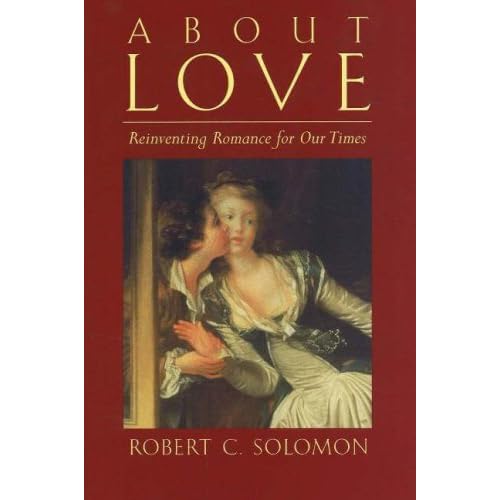
Solomon, Robert C. About Love: Reinventing Romance for Our Times. Lanham, Maryland: Madison Books, 2001.

About Love BookRobert C. Solomon was the Quincy Lee Centennial Professor of Philosophy and Business at University of Texas at Austin whose untimely passing caused me great sorrow. Solomon was one of the few philosophers who would write about love. I must confess that I have read many works by Solomon becoming a great admirer of his writings and even interacted with him a few times at conferences. So, I am far from a neutral observer and even though I have never claimed to be unbiased in my ramblings on some of the books I have been reading, I think this goes further. There is something about being familiar with a person’s works that changes how you view them. This is true of my readings of Aristotle and Nietzsche. When I am reading About Love I have a background in Solomon’s thoughts where answers (or even questions) that others may be wanting in this book occur to me because they have been explored in his other works. Also, I have a sense of what he is writing about that may be unclear to a person who is reading his works for the first time. I do not think that being familiar with his works is better. I remember when I went to see Ani DiFranco having never heard her music before, it is like your first kiss with a person not knowing what to expect or how it may change your life. Yet, having that familiarity provides appreciation because of the intellectual background to the work. I may forgive a misstep here and there or recognize the value of his discussion about emotion. Why this long introduction, well in part, because it is akin to About Love. Solomon writes about the problem we face when thinking about love. There may be nothing like the rushes of the beginning of love that first kiss, embrace, and sex. All those little things you learn about the person. Yet, Solomon suggests there is something about love in which two people build a life together. What I would suggest is that it is like traveling down a path together. Oh, you may get sidetracked, loose your way, or even stop but so long as you have that future together in mind there is hope. In fact, Solomon suggest one the conditions of love is to have that idea of future.

Solomon’s book on love is more of a long essay about love and emotion. He has written on emotions before so does not delve into a lengthy general discussion on this topic. However, he does give one of his main points that “Emotions are not feeling, even when emotions are bound up with feelings” (78). Solomon does not see emotions as opposite of rational thought. Emotions are part of rational thinking. I am not sure if he would put it quite this way but from his works and meeting him, Solomon suggests that our emotions have reason behind them, be they good or poor reasons. However, there is nothing bad about emotions because they are very much part of being human. As he writes, “The emotion itself is a form of intelligence, a set of judgments, a way of seeing the world” (78). So that love is like all emotions, which as Solomon writes “is a product of the will” (78). This is where you can see the influence of Nietzsche and Schopenhauer on Solomon.

So then what is love? Well for Solomon, “Love at its best is a convergence—a synergism—of many desires, some of them sexual, others ethical, many of them straightforwardly practical, more than a few of them romantic and fantastic” (94).  These are themes he follows throughout the book. However, it is his chapter on the idea of “Falling in Love” where I think he is at his best. Falling in love is a choice. This is where I think many readers will stand up and say no, that falling in love happens, perhaps by fate or chemistry but not by choice. However I am in line with Solomon on this matter. Now part of the problem is with what love is. So that the process of falling in love should not be confused with just the beginning where feelings, sexual urges, and fantasy all co-mingle but it is not the same as love, only a start that often falls away or never gets the chance to really develop. The beginning may be a great time filled with breathtaking heights; however, there are choices we have to make even before getting there. Part of this is how we think of love about first sight. If love at first sight were always true then we may see fate handing us love but often love at first sight fails us. Although we often remember only the times love at first sight was more successful, forgetting those short times in which we thought that person was “the one.” There is more to falling in love with how society, biology, and our own choices influence those beginnings even if we do not always understand them. These ideas are covered on his chapter on “Identity and Love.”

I think his own words will do better than my own on this, where Solomon says, “Of course the self can be determined only against a background of ‘givens’ that are beyond dispute-from the time and place where we were born to the fate and circumstance of our bodies, our looks, our talents and opportunities” (200).  This is not to say that we are simple the sum of background facts. “We are never simple passive victims; we are always the coauthors of our own personalities” (200). Then finely he writes about making love last. This was the shorter part of the book and lacked the insight of the rest. Perhaps the topic is just too hard or needs a book of its own, maybe I was just not in the place for it. For reading a book only once means that I miss many points and ideas because I was not in the right time and place for all the ideas.

Like I have said, I enjoy Solomon’s writings and this book in particular. Yet there were some things I would have liked to see included. There is neither an index nor a bibliography, both of which I would have liked to have had. Footnotes would have been helpful (I made some of my own in my copy) but I understand that this is a popular work and not intended for scholars. These are small distractions and are of a minor concern to a truly great book. Let me leave you with one last passage from Solomon, one that I kept coming back to, where he writes, “Ultimately, there is only one reason for love. That one grand reason, which was seen so clearly by the ancient but has gotten lost in the modern stress on individual autonomy, is ‘because we bring out the best in each other’” (155).

Posted in Book Review, Philosophy | Tagged , , | Leave a comment

WECSOR Conference 2011

My head is still full of ideas, comments, theories, and connections from the American Academy of Religion’s  Western Region (WECSOR) meeting at Whittier College. It will be months for me to process all interesting conversations from this conference. However, here is an overview of those panels that I attended.

The Plenary Address by Professor Pierrette Hongagneu-Sotelo, University of Southern California, focus on her finding of religious and immigrant rights movement. It went beyond just showing how religious organizations are involved with social rights movement to how these movements can use religious rituals such as La Posada Sin Fronteras.

The joint session in Philosophy of Religion and Psychology, Culture, and Religion focused on Bringing God to Mind. Eric Kyle, The Claremont School of Theology, spoke on “The ‘Paradoxical-Transcendent’ Mind: Is a Cognitive-Neuroscientific Understanding of Mystical Thought Possible?” But this gets better with his use of Pseudo-Dionysius works such as On the Divine Names and Mystical Theology along with Daniel J. Siegel’s The Mindful Brains: Reflection and Attunement in the Cultivation of Well-Being and Jean Piaget’s theory of Cognitive Development. Basically building on the Neo-Piagetian ideas of cognitive development moving from particular knowledge to broader systems and then to holding different systems at the same time such as both an immanent and transcendent idea of mystical thought. I see this very much in line with the work of T. Thorn Coyle.

I attend two panels on ethics. The first one was on The Ethics of Religious Pluralism and Tolerance where Roy Whitaker, Claremont Graduate University, talked on “Martin Luther King Jr.’s Theory of Pluralism: Implications for Religious Tolerance.” One of Roy’s projects is to bring awareness to King’s work of reaching across to Jewish and Hindu religious communities (perhaps more but these were his examples for the talk). Roy’s ideas spark my own thoughts on the Pagan community and whether we want to be just tolerated or we want to be engaged. King did not just tolerate other religious communities but engaged them. I can see this happening for the Pagan community with the Hindu-American Society attendance of the 2011 PantheaCon. For the second panel on the next day (Common Foundations of Religion and Ethics) Michael Fegert, Claremont Graduate University, reinforced the idea of the human predicament with his “Normatively in Religious Pluralism: Historicism without Relativism.”  Will Mittendorf, Claremont Graduate University, in his “The Effects of Intra-religious Partnerships on Public Reason” worked on the problem of having religious idea within public reason showing how secular approaches from religious groups could still be genuine within public reason and still move forward with religious principles.   

There were many more speakers I listened to in these panels and I attended more panels such as Religion and the Arts (Negotiating Conceptual and Geographical Boundaries) and Ecology and Religion (Edges of Eco-theory).  However, as I said, I will be thinking on all this and see where it may take me.

Posted in Classes and Workshops | Tagged , , , , | Leave a comment

Paganism and the Inner Critic

The other day, I had a conversation with a friend who said she would love to write, but wasn’t good at creative writing. I encouraged her to try other forms, like poetry. This was met with something that resembled panic. “Oh no! Nobody wants to read that!” She responded. She went on to explain that if she started with short fiction, and got some good critical feedback, she then might be able to venture out a little further. This got me to thinking. I have spent the last 20 years trying to let go of the idea that to be able to create, we need a license through positive feedback on our art. (I use the term art here to mean anything that involves the creative process.) I somehow, like my friend, have the idea that, for art to be meaningful, we need permission to create.

I have read many things about turning off the inner critic, and letting failure be a learning tool. I sometimes wonder why this is so difficult to do. And I admit, being fully human, I still seek approval. I think that we often see art as a separate part of our everyday lives. We have difficulty “owning” anything we see as a failure. And we have been entrenched in a culture that obligates us to acceptance before we feel that we can move forward. From a Pagan perspective, it helps me to know that art is an expression of our humanity and a reaction to our daily lives. Art is a way to understand and connect with the deepest parts of ourselves. Art can be a very spiritual experience, but it doesn’t have to be. Sometimes it is a communication between parts of ourselves and with the world. In Drawing Down the Moon, Margot Adler says “Neo-Paganism returns to the ancient idea that there is no distinction between spiritual and material, sacred and secular.”(pg. 11) If we embrace this idea, there is no failure. We shift into another reality and an outcome is just that – an outcome. Not good or bad, but a product of a journey we have taken. Sometimes the outcome is unexpected and not what we first envisioned, but we can be open to the idea that the value of it exists, not in the feedback, but in the act of expression itself. This can open us up to broaden our perspectives on, not just the perceived value of the finished product, but the entire process.

Posted in General Post | Tagged , | 1 Comment

Pagan Humanism (A working title.)

The other evening at my local meet up event, we had a book share out. When it was my turn, I stammered and stuttered about the general idea of the book I had chosen, practically reading the subtitle verbatim as an endorsement. Ever had one of those moments?

Drawing Down the Moon Book CoverThe book I had chosen to share was Drawing Down the Moon, by Margot Adler. I had just received it in the mail earlier that week. I had never owned a copy, but as a starry eyed teenager, it was the first book on Paganism that I had read that made me think, “Aha! There’s a name for what I believe.” So I guess when I got it in my hands, it triggered that sixteen year old girl inside of me that sat cross legged on the floor of the local public library having her first spiritual epiphany. It has been many, many years since I read this book, but I remember it as a really thorough sampling of the diversity of Paganism in America.

After group, I went home and thought about it. Why did this book, even though I remembered very few details about it, have such a great emotional impact on me? Then it came to me. This was a very real look, from a very human perspective, at the diversity of the Pagan religion. As a teenager and young adult, I looked at Wicca and a number of other belief systems, none of them felt quite right for me. I eventually understood that “Pagan” was a much broader umbrella under which I could comfortably stand. Eventually, over time I began to break down and explore the ideas in which I believed. This led to many discussions with William about what ideas we had and how to embrace them. We began to give it a name. Pagan Humanism. (I like to think of this as a working title.)

Later that night, something struck me. My first introduction to the idea of Paganism was broad, varied and presented in real life scenarios. I truly think it opened me up to a bigger idea. The idea that there are so many truths, that through living, you have to find out which ones are right for you. I would have loved to have shared this with the group, but at that moment, I was so emotionally engaged, I could not express my thoughts. This is a wonderful forum to work within. I can now take my time and say what I mean. And now I plan to go and reread my copy of Drawing Down the Moon. And if you’d like to read it too, we have provided a link.

Posted in General Post | Tagged , | 4 Comments

Tsunami, Taking Actions, and Piety

I woke this morning and checked my twitter account (@williamblumberg) to find that a major earthquake occurred near Japan and that a tsunami had already impacted some coastal areas in Japan. My heart goes out to all those affected by this natural disaster. One place for information is the American Red Cross Disaster Online newsroom. You can also make donations there too. Having volunteered with the American Red Cross for five years, I am happy to support them but please know that there are many good places to donate if you so wish.

This brings me to my topic today: taking action as a means of piety for Pagans. The Pagan Blog at Patheos has offered “Praying for the Pacific.” Thanks Star Foster for offering an Homeric Hymn to Poseidon (I think it was the Hugh G. Evelyn-White Hesiod, The Hymns and Homerica, translation from the Loeb Classical Library).  Star took an action that I think constitutes a pious act. Let’s look at one of the most famous explorations of piety in Plato’s Euthyphro.

Plato has Socrates and Euthyphro try five definitions of piety, including the reworking of some. They are what Euthyphro is doing now (5d), is that which is dear to the gods (6e); what the gods approve (9e); Socrates’ definition which is a rework of the last one where what the gods love is pious and hate impious  or (12d); looking after the gods (13b); or form of commerce (14e). See Thomas C. Brickhouse and Nicholas D. Smith’s Plato’s Socrates and Mark L. McPherran’s The Religion of Socrates for a robust development of piety for Socrates and Plato.

So when we offer a hymn or prayer to the gods, is it because that is what we should be doing; the gods holds dear, what they love, are we looking after the gods, or engaging in a form of commerce by giving the gods what they want and getting what we want from them? Here is my very Pagan Humanist view: I do not know because I do not understand the nature of the gods (this idea will need to wait for another blog posting). I think there is much hubris in claims about knowing the gods. What I am left with is understanding piety in human terms. So is making an offering to the gods being pious? Yes, it is about creating right relations and that include the gods even if I am unsure about their nature. Nor would I want to limit what are right relations are because of its complexity. To provide simple one line definition to any complex human interaction, such as piety, is subject to difficulty. Socrates (well the way Plato tells the story) attempted this and ending up with wanting to return to the very beginning of the conversation with Euthyphro by the end of the dialog to begin again this search for what is piety. Philosophers often offer good questions but not always good answers because the world is often more complex than one answer.

In my study of piety and Paganism, I still do not have nor do I think I will come across a simple answer to specifically what is piety. As best as I can, right now, I will hold to this general sense that piety is building right relationships with deity, nature, people, and one’s self.

Posted in Philosophy, Piety | Tagged , , | Leave a comment